
Earthquake Gas Shut-Off Valve Installation in Murrieta, CA & Surrounding Areas
Why Seismic Gas Shut-Off Valves Exist
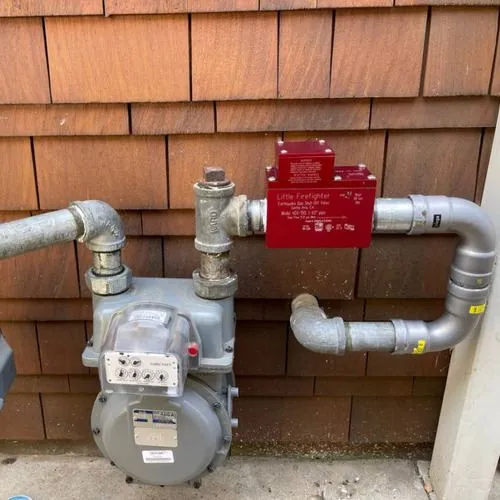
The fire risk after an earthquake is mostly a gas risk. Shaking can shift appliances, snap fittings and pull flex connectors loose, and a broken gas line in a damaged house is how a survivable quake turns into a fire. A seismic shut-off valve is a simple, certified mechanical device mounted at your gas meter that closes automatically when it senses strong shaking. No power, no batteries, no electronics: just a calibrated mechanism that trips when the ground motion is severe enough to threaten your gas lines.
Is One Required?
It depends on where you are. A number of Southern California cities require a certified seismic gas shut-off valve when a home is sold or significantly remodeled, and some insurers offer discounts for having one. Requirements change city by city, so check your local ordinance or ask us and we will check for your address. Where a permit is required, we handle it as part of the installation.
How Installation Works
The valve is sized to your meter and gas load, mounted plumb on the riser downstream of the meter, and tested. Using a state-certified valve and mounting it exactly level matters: a tilted valve can trip on the wrong motion or fail to trip on the right one, which is why this is not a bolt-on afterthought. After any earthquake that trips the valve, the reset procedure is straightforward: shut your appliances off, reset the valve, then relight pilots. We are happy to walk you through it by phone or come out and check the system over.
Part of How We Do Gas and Water Work
Seismic protection is baked into our standard installs, not an upsell. A recent water heater replacement we did in Banning shipped with an earthquake strap, thermal expansion tank, new gas flex with valve, drip leg and drain pan as a matter of course. If you smell gas or suspect a leak right now, treat it as an emergency: leave the house and call from outside. We answer at 866-693-2645 24 hours a day.
Related: gas leak detection, emergency gas leak repair and gas line repair and replacement.
Frequently Asked Questions
Will the valve trip on every little earthquake?
No. Certified valves are calibrated to actuate on strong ground motion, roughly the shaking of a magnitude 5.4 or greater event nearby, not on a passing truck or a minor tremor. That calibration is exactly why proper, level installation matters. The mechanism is mechanical, not electronic: a calibrated element inside the valve responds to actual ground acceleration, so it needs no power or sensors and cannot be set off by household vibration. Slamming doors, passing trucks and the minor tremors Southern California produces routinely all sit below its threshold, which is why nuisance trips are rare on a correctly installed valve.
Can I reset it myself after it trips?
Yes. Turn your gas appliances off, reset the valve at the meter, then relight pilot lights. If the earthquake was strong enough to trip the valve, it is also worth having the gas system looked over before you trust it again, and we can do that check. The reset itself is a simple turn of the mechanism at the meter, and the valve is designed for homeowners to do it. The caution is about what happened during the shaking: strong ground motion can loosen appliance connectors and flex lines even when nothing looks wrong, so a leak check before relighting is cheap insurance.
Do I legally need one?
It varies. Some Southern California cities require a certified valve at point of sale or during major renovation, and escrow sometimes surfaces the requirement. Tell us your city and we will check what applies to your address before any work is quoted. Even where no ordinance applies, the case for the valve is what happens after a major quake: a broken gas line in an empty or damaged house can feed a fire long before the utility can respond, and shutting the meter by hand assumes someone is home, uninjured and knows where the wrench is. The valve removes all three assumptions at once.